Pages

Showing posts with label burrocrazy. Show all posts

Saturday, March 2, 2019

Power, Veterans' style

"Power is defined as seeing something that needs to be done, and doing something about it.  By that definition, Sonny is one of the most powerful men I have ever met."

Yesterday, I traveled to St. Louis to honor a friend of mine for his retirement, and this was how I introduced Dr. Sonny Trimble. It is true.  The guy is larger than life, and have incredible respect for the guy and his work.  A few of the things Sonny did:

- Led the excavations of 50,000 murdered Kurdish civilians, buried in a mass grave.  The effort
resulted in the conviction of Sadaam Hussein for genocide.  He testified at the trial.
- Led the team that reburied the remains for the Kennewick Man,
- Led efforts to locate and return remains of POWs from the Vietnam War,
- Renovated and re-placed the gates at the Arlington Cemetery,
- Led the excavations and reburial of the African Cemetery in New York, and
- Curated and shipped the remains of one of the T-Rexes that belong to the Corps of Engineers, to be displayed at the Smithsonian.

Sonny at Arlington.
Image stolen shamelessly from Wake Forest U Magazine
But the thing that Sonny is probably proudest of, and justifiably so, is the work he has done with the curation of artifacts that the Corps owns.

Sounds pretty boring.

It is not.

See, when Sonny came to the Corps, the archaeology that was done focused exclusively on getting the stuff surveyed/excavated, analyzed, labeled, and then put into a collection.  We really had NO idea what we had, or where it was.  Sonny initiated the project that went around the country and identified the locations of our collections, and made sure that we had good records of them.  Where necessary, the project was responsible for stabilizing, photographing, standardizing, and compiling all of the data related to the collections.  And, eventually, the project moved into consolidating those collections into regional repositories, where everything could be together.

Sonny could have hired archaeologists for that.  We work cheap, and we are always looking for steady work.

But this is where Sonny made it special.He decided to get a different group involved.  Sonny developed the Veterans Curation Program.

The VCP hires veterans returning from tours overseas, and works with them to translate the skills they have into marketable opportunities.  Someone who has served his country as a 14G might not know how to present those skills in a way that would parlay them into a civilian job afterwards.

But the VCP does.  The whole process of artifact curation is broken down into component parts of tasks and jobs that are replicable outside of the program.  Photography, database work, organization skills, office skills, project management skills, report writing skills.... basically building a resume while doing meaningful work in the Federal government.

The stories that were told about the program were heart rending.  Sonny's program has made a difference in thousands of people's lives.

After the presentation and the reception, I took my leave, and got on my flight back home.  As we landed in Jackson, Mississippi, the captain asked us to remain seated.

"Ladies and Gentlemen, this is your captain speaking.  We have had the great honor on this flight to transport the remains of an American serviceman who was killed overseas.  Please remain in your seats until the soldier accompanying the remains has disembarked."

I have never experienced anything quite like that moment. It was the end of a long day for a lot of people on a full flight.  We were all tired and anxious to get home.

But everyone stopped and fell completely silent as a soldier in dress blues came from the very back of the plane, and exited without a word. Even after he left, we were reluctant to move.

We talk about supporting the troops.  We believe in patriotism and we believe in America.  And sometimes, there are people who go out of their way to make America a better place.  Some of them, like Sonny, find ways of making the place soldiers return to a better place by providing opportunities for experience.  Others, like the soldier accompanying the remains of the fallen brother, work to honor those who have made sacrifices.

Others give everything.

They all see things that need to be done.  And they do it.

Power.

I pray for the family of the returned soldier.  I pray for the soldier with the honor of doing the terrible duty of accompanying the remains, returning a box to a grieving family.

And I thank God for the work being done to help those who return, as they do the hard work of integrating into a society that sometimes struggles to find a place for returning warriors.

Thank you, Sonny.  I salute you.

Tuesday, January 30, 2018

Turn the Lights Out When You Leave

I'm home.

Still trying to figure out which end is up.  I arrived a little over a week ago, late on Thursday night, weary and shell-shocked.  Eight days later, I am just starting to get my feet under me.

People want to know how the trip was.  Whether it was fun.  How I liked it. Where my suntan is.

Fun?

I'll sum it up, just to make it clear.

My deployment was brutal, but important.  Given the different permutations available, I will take that combination, every single time.  Gimme important battles to fight with real consequences, and let me see how I can help.  The work was hard, and the reasons were complex, and there were battles raging on all sides.  Some of them were overblown (including an honest-do-goodness "fake news" story - see below).  Some of them were unnecessary.  And then some of them were

Tuesday, January 16, 2018

Unfinished Business

November 19, 2017, 2330 hrs: Crorey arrives in Puerto Rico. 

A couple of days before my arrival, I saw this video that inspired me:

https://twitter.com/USACEHQ/status/930799330398699520

...and that video set the tone for expectations for the two-month effort.  It is true.  I fully expected to hear those cheers regularly.  I mean, I was not going to be the field guy, but that cheer when the lights went on was both the goal and the expectation:  I envisioned videos every few days from the field, as people get charged up, leaving me charged up as well.  I was going to be building relationships, fighting to get funding to get the mission completed, working to do the job. Bringing lights to the people of Puerto Rico.

Fifty eight days later, I am two days away from leaving a situation that is not yet fixed.  I am leaving behind work that still needs to be done, and it is work that needs to be done in areas I thought would be complete by now.

The work is not complete.  I am leaving without having done what I thought I would be able to do.  There should be a feeling of satisfaction that accompanies the completion of a mission, a sign that announces MISSION COMPLETE!

Or, at the least, there should be a profound sense of accomplishment associated with furthering the mission.  I am just a cog, but I am a cog in a significant effort.  And I am adding my weight to the pushing.

I am struggling to get my arms wrapped around what I am feeling right now.  It is not disappointment in my effort or in the mission.  The situation needed our attention, and it needed that attention right away.  We came in and pushed as hard as we possibly could.  It was, and is, a good mission.  It has been an incredible effort.

It also has nothing to do with the people working the mission.  Everyone I met - with one notable exception (adult beverage conversation) represented the best of what the Corps of Engineers brings to the work it does.  They are dedicated.  They work hard. 

Monday, January 15, 2018

Changing the Mission

"In 8.3 miles, take a left on De Diego Boulevard."  The voice on the navigator's iPhone counted down as we got closer to our destination.  "In 7.5 miles, take a left on De Diego...."

Ugh.  I hate the talking map.

But regardless of my feelings about it, the voiced gps is a critical tool here.  So today we were listening to some disembodied voice tell us where to go, and we followed it blindly.

In between instructions, I thought of how our mission has changed since we first came.  When we first arrived in Puerto Rico, we were desperate to get people and material onto the island (well, we are still desperate to get materials here).

Empty trucks parked on the yard in the middle of the day.
But we are now focusing on a whole new set of variables.  How do we increase productivity on a time-and-materials contract?  How do we ensure that the lines are assigned to crews who can complete them fastest?  How do we acquire access to staging areas where we can put stuff where it is easy to get to?  When do we stop using the generator that we put in to power up a community down south?

As we answer those questions, our focus changes.

It really isn't all that different from listening to the disembodied New Zealand female voice defining the road I am going down.  She can't really see where we are going, she doesn't know what the traffic is like (I know, current technology is getting there, but still), and she doesn't know what tree has fallen across the road and is going to make us turn around and find another route.

She also gets stuff wrong.  Sometimes she sends me down a one-way street the wrong way - which happened.  Or tells me to take a left, which would take me across a four-foot concrete barrier and across oncoming traffic on a six-lane highway - which also happened.  Or takes me to a gated community that is ALSO named Calle 2....

But she knows where the roads are.  And she gives you a good general map of the landscape.  And she can help navigate the way there.  She can even re-calibrate your path, depending on which gated community you accidentally turned into.

Our plan of action - every plan of action - is the same way.  We have a lot of information that we use to come up with the path we will follow.  And there is a certain point at which it is better to commit to the path you are on, despite a little bit of traffic (we got stuck for 45 minutes in a choke-point on the road today, because we weren't willing to find a new path).  Until there is clear benefit for changing the path, we stay the course.

But if we are clinging to the words on the page - the road map we agreed to at the beginning - we are sending bad money after good.  Some times, we have better, more recent information than we knew when the plan was established.  When that happens, our path changes.

"In 4 miles, take a left on De Diego...."

We are further down the road.  We are no longer where we started, and slavishly following the original instructions is stupid.

We took a left on De Diego.  We got to the yard.  We counted trucks and talked to the yard manager.  We got information about how desperate they were for the materials.  We heard about their concerns about salvaging the material from old poles.  We took down names.  We got a feel for the frustration they feel, about the safety concerns (a guy fell 50' from a tower last week - and survived) and about what they need to do their work well.  Some were defensive.  Some were challenging us.  Some evaded.

All of them are here to fix the problems.  All are going down the path with us.  And trying to bring the lights back on.  Suggesting different paths, arguing with us about how to light up the island.

They are like us.  They are here.

Estamos aqui.


Saturday, January 13, 2018

What is Wrong?

This situation is a mess.  Despite everyone's hard work and great intentions, the situation here is just rough.

We have so many problems, that I have to number them.

1.  When the Corps of Engineers came down to Puerto Rico, we were tasked with doing one thing.  Eventually, the work we were doing was morphed into something else. And then something else.  First we were restoring the grid (ESTAMOS AQUI!).  Then we were restoring all power to everyone (YAY!).  Then we were restoring some power, and working with the local utility to bring the rest back (POWER TO THE PEOPLE!).  It is difficult, however, to capture the flag if your end zones keep changing.

We are working in partnership with FEMA, who is providing the funds, and with the local electric board.  PREPA is a public utility, they are flat broke (having declared bankruptcy in July of last year), they have a system that is hopelessly outdated, and are almost entirely made up of people who replaced their predecessors, many of whom got fired after the storm.

The media reported on something this week that demonstrates a serious issue.  There is a warehouse that was under the control of the local public utilities company.  Apparently, there was a bit of consternation about the fact that they were not coming forward with the stuff that was stockpiled there.  The lead from FEMA gave the strong impression in a stakeholders meeting that she was not above using Federal Marshals to storm the place and turn the materials over to the contractors doing the work.

The story here gets a little muddy.  But the best I can figure out, the warehouse was filled with materials from dead projects.  You know, like that 1958 Ford Fairlane that you have in your garage, but have never been able to complete?  The parts are stacked up, but you have completely given up on getting it running again.

And yet, if someone asked you for parts for fixing cars, you might not think of your Fairlane.


That is kind of what the current situation was with the power company.  They had dead project stuff.  Not well catalogued.  Not usable for regular maintenance.  Not on anybody's radar.  There is also suggestions that the information about what was there had been made available, but that the right people did not know about it.  (The communication issues following a disaster is a whole different blog entry).

Friday, January 5, 2018

So what do you do? Emergency Management Edition


If you are a traffic cop, and you can't come up with an answer when someone asks you what you do, then there are going to be some collisions until you get it figured out.

I arrived in Puerto Rico on 19 November, back-filling for a program manager who was rotating back home.  And every day, someone different asked me what it was that I did.

Response, Day 1:  I am the new Dave Jenkins.
Response, Day 2:  I am the new Dave Jenkins.
Response, Day 3: I am the new Dave Jenkins.
Response, Day 4: I am the new Dave Jenkins.
Response, Day 5: Um..... I am not so sure.

A week into my work, I stopped trying to figure out what my predecessor had done the week before, because it obviously had no bearing on what was being done today.  For that matter, whatever it was that I did yesterday had no bearing on what I was doing today.

Under normal conditions in Vicksburg job, I consider myself a firefighter.  As soon as the fires flare up, I run over and see if I can help put them out.  (I have even set a few fires intentionally, in order to get my projects the attention that they need.  Then I get to swoop in and put out the fire).

I also worked emergency operations as a local government liaisons following a number of disasters, and so I am familiar with how it works, and the importance of changing your focus on a moment's notice.  But even so,  the definition of what exactly I am doing here eluded me.  Program Manager sounds great, as a title.  But what does my day-to-day look like? I couldn't really answer.

I mean, shouldn't that be a red flag?

Then, three days ago, I got myself a better explanation of what I do.


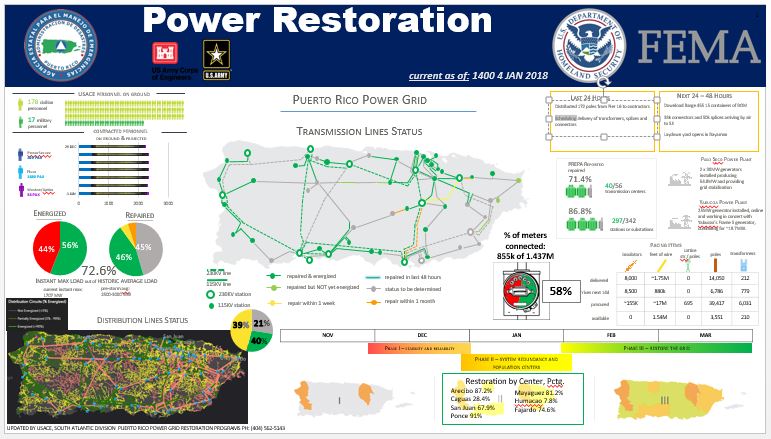
Very busy slide.  Lots of info.
Every day, I read a series of reports and make updates to a single slide.  The slide is used by FEMA to discuss progress with the program.  It is both the worst thing ever for me - because it requires very minute attention to detail - and the best thing ever for me - because it involves me reading lots of reports for information that I need to understand. 


The coolest part of it is that I am seeing changes over time.  The slide shows areas that are powered.  It shows the workforce in the area dedicated to the work.  It shows the status of the material and when we can expect it (a plane full of transformers arrived yesterday).

Flying is faster but  more expensive way of getting stuff to the island.
And over the course of two months, I have gotten a sense of what changes are occurring, and I track the changes.

The slide I build gets shared around quite a bit, and is used to oversee progress on the program at a very high level. And as of three days ago, at a much lower level, too.  I received an email.

>Sir,
I am the local government liaison mission manager.  Our liaisons in the field are constantly getting asked about the power restoration mission.  At this time I do not get any talking point or briefing slides from this mission.  Can I please be included in any distribution of these documents so that our liaisons in the field will be knowledgeable and aware of what we are doing.  Currently they are reading things in the paper that they are not aware of and probably should be.
I appreciate your help.<

Immediately, I moved into action.  I started sharing information.  I know what it is like to be in the field, getting no information, and being asked for insight, all the while hearing from others what your agency is doing.

I shared the slide.  I shared the critical reports I had pulled the information from.  (And then asked for permission).

That same day, I received two panicky requests from the field.  Both were getting demands from officials for specific information, and were reaching for a lifeline.

I immediately reached out to a contact I had, and told them about the need.  Contact was made, information shared.  Fifteen minutes later, I get the following e-mail:

All, a direct quote from the FEMA Division Supervisor "This is perfect! Exactly what I needed!"

Guys, feedback between firefighters is rare, especially in the middle of the battle.  So for him to pass back the message meant that he had been especially desperate for the information. (Or, perhaps, he was just exceedingly polite.  A trait that burns out pretty quickly in the heat of battle).

Suddenly, I see my own position in a new light.  I am not a vaguely defined 'Program Manager'.  Or, at least, I am not only defined by that title.

I am the connector.  I am the purveyor of information.  I take packages of information,  I repackage that information, and I get it into the hands of the ones who need it.  I have elves who give me the work of their hands, and trust me to get it delivered to the right house. For all the good girls and boys.

I am freakin' Santa Claus!

A friend of mine, Danielle Tommaso, is the best I have ever seen at playing Santa Claus.  She collects information, completely repackages it in easily digestible bites, and feeds it to people who need those bites.  But even if I am less talented than she is, I do wear my own red hat, and drive my own reindeer.

And when I get to share the knowledge I develop with people who are in need...

...it is like Christmas morning. 

Estamos aqui.


Saturday, December 30, 2017

Shipping the Goods

Gratuitous pic of a truck replacing
a line on a narrow street.  Photo by Kathe.
"We have scavenged all the materials we can from damaged poles and lines.  As of Tuesday, we will be out of materials to continue work on the electrical lines in the city."

The Mayor of Villalba, Puerto Rico, was talking to a group of officials from Puerto Rico Power, FEMA and the Corps.  He shared the extent of the damage done, and what remains to be done.  Today marks the 100th day since the storm hit.

Villalba, for those of you not familiar with the geography of the island, is not the most remote town in Puerto Rico.

The utilities official agreed with the mayor.  If materials were on hand, 60% of the lights in the village would already be energized.  And then everyone turned and looked at the representative from the Corps.

Arms folded.  Well?

This scene has played itself out in similar scenes all across the island.  Because of a host of logistical problems with getting stuff shipped to the island, teams from every contractor and subcontractor have taken valuable (read:expensive) time to recycle for reuse any available scrap from the lines that were destroyed.  Wire coiled and set aside.  Boxes filled with scavenged connectors and insulators and bolts.  Stacks of crossarms.

We have been struggling since right after the storm to get material where it needs to go.

We have a group of guys who we refer to as the BOM Squad.  BOM - Bill of Materials - is the physical stuff we need to do the work.  From day one, the BOM Squad has had the hardest job on the island. They are responsible for moving tens of thousands of power poles, hundreds of transmission towers, thousands of insulators, hundreds of transformers, wire, (LOTS of wire), and tons of nuts, bolts, crimps, and other stuff with exciting names like "Fuse Link 140A dsv Universal Fast" or "Cutout KVMAS 200A" - and getting it all where it needs to go.  (Fun fact: there are chainsaws in the mix, too.)

Here's the thing: If you don't have all of the pieces, then you don't connect the electricity, and you don't turn on the refrigerator.  And people fold their arms at you and stare.  Well?

The BOM Squad made their order based on very early information about what the needs were, with a lot of uncertainty in what the actual needs were.  And there have been countless bottlenecks:

Bottleneck at the manufacturing facility.  Much of the stuff we are getting in every day is stamped with a production date from last month.  That is unheard of.  We have been literally having stuff manufactured, rolled off the assembly line/out of the kiln, stamped, and immediately put on a truck.

Bottleneck at the port, where the stuff was supposed to be loaded on barges.  Eventually, we moved all of the stuff to a different port. And shipped it out from there.

Bottleneck at the port on the island.  Taking the items off the barge, putting them down in the yard, opening the containers, cataloging, counting, repacking, setting them on trucks, distributing them to the laydown yards.

Bottleneck at the warehouse.

They have been streamlining, and the process is better.  But there was no material on hand.  EVERYTHING had to be shipped.  What is worse, original estimates have changed, and items have been added.  With no change in the timeline.


And then how do you determine who gets priority for receiving the stuff?  No matter what you decide (First come/first served?  Big city first?  Industry first?), you will be charged with favoring one group over another.

'The Corps favors the contractors they hired, and are not giving material to the locals who need it.'
'The Corps is favoring one contractor over another.'
'The Corps is favoring the locals over the contractors, who cannot perform according to the contract if they don't get the stuff.'
'The Corps is favoring one region/one village/one town over another.'

Now, two months after the order was made, we are starting to see an increase in the stream of goods that are coming to the island.  Every day, we are counting containers of material, hundreds of poles, and getting more stuff into the hands of the contractors and workers who can majically turn bits of metal into electricity in the homes of those who need it. And they won't have to rely exclusively on cannibalized material to do it.

We are answering the question from the Mayor of Villalba.  We are ordering material and providing it as quickly, distributing it as widely, and helping as many people as we can.  As soon as we are told of the need for specific elements, we order them and get them in.  As they are received, we turn them over to the team needing the material.  To get them back to work.

The trickle of BOM is turning into a stream.  And soon, God willing, the stream will turn into a river.  As that happens, we can get it all into the hands of those who can bring power to the people.

Estamos aqui.

Even in Villalba.


Thursday, December 21, 2017

Watering the Turf

I hate turf wars.

One of my jobs back in Vicksburg is to hold a monthly discussion session with people on how to collaborate.  My team pulls people together who are struggling to work together, helps them identify a common goal, and gets them talking.  Sometimes it is easy when we have an easily definable common goal.  Other times we have competing missions that make it impossible to do so.

But my job is to start people talking and sharing resources.

An simple example of something that worked this past year:  We had a significant re-org in our office, and we were thrown into a new group.  And the time with the boss is the scarce resource, and we were competing for it without discussing the problems among ourselves. We weren't talking.  There was no hostility.... but there was no relationship.

Individually, we were talking.  Some of us, anyway. But we needed to talk regularly.  And our weekly formal briefing meetings were not cutting it.

I instituted a CrockPot Thursday.

Every Thursday, I would put some large hunk of meat - pork, beef, chicken, wild boar, venison, sausage, whatever - into the pot.  And I would put in all of the supplemental pieces of deliciousness - potatoes, celery, carrots, pasta, kale, garlic, onions, and other stuff.  Most of the time I'd make a pico de gallo to accompany it.  And the vehicle for getting it in - tortillas, baguettes; sandwich bread, rolls... and the sour cream, mustard, hot sauce - we did it all.

Monday, December 18, 2017

The Last Mile


Where do we stop?

As a representative of the US Federal Government, I find it to be a significant question.

In my agency, we answer the question - in some form - every day.  The feds have nothing to do with paving your street.  The feds don't get into the business of trimming the trees on the railway lines, or throwing away garbage.  They don't make sure that your boat's slip is deep enough for your boat, or that your carport's roof doesn't leak.  For our day-to-day decisions, we have a concept of what comprises Federal Interest - what makes an investment to be one of national importance.  If it does not rise to that level, it might be nice to do, but it is not in the purview of the Federal Gummint.  (Unless Congress tells us that it is, which happens from time to time: see New Orleans' SELA project for an example.)

In times of disaster, however, those lines get blurred a lot.  We tend to do things in the wake of a disaster that we don't normally do, just to make it so people can get their lives re-started.  Things like blue roofs.  And debris cleanup.

And like my work - power restoration.  (Not usually a Corps mission)

But how far do we go to complete the mission?  Do we deliver electricity to the substation?  To the last transformer in the neighborhood?  To the power pole next to your house?  To your house?  Inside your house?

Saturday, December 16, 2017

The Beauty of Recovery

When I arrived in Puerto Rico, just a few days before Thanksgiving, almost two full months has passed since Maria made landfall in Puerto Rico.  And I don't know what I expected to find.  But even then, there were indications that recovery was going to be fast and slow.

Amazing food, everywhere - the kitchens were open.  Lots of hustle and bustle.  Grocery stores, stocked with food.  A few shelves were a little threadbare, but there was nothing that I needed that I couldn't get.  Well, except for a hotel room....

I came in to my office on day, and on the way I saw some beautiful flowers, and almost immediately fell in love with the tropical paradise.  It was as if I was hearing half of the song from West Side Story:

Always the pineapples growing, 
Always the coffee blossoms blowing . . . 

Yes.  It is still a disaster zone.  There were piles of debris.  There were downed trees and power lines.  There were buildings with broken windows.

And then, there were some trees that had just started to put on leaves, despite the hit.

Plumeria with a few remaining leaves.

All the leaves that remained were tattered, and most were ripped off.  But there was, at least, a little evidence of what could come back.

Thursday, December 14, 2017

What is your estimate?

Quick:

Your power is down to your island.  You haven't even had time to assess, and there are people who need answers today.  How many lines need to be repaired?  How many lines need to be replaced? How many towers do you need?  How many transformers?  How many insulators?

Just days before I arrived here in Puerto Rico, there were a hundred people in a massive meeting, and they came armed with forms and numbers and assistants who carried more of pieces of paper with more numbers. The cost estimator stood up, pointed to the spreadsheet projected on the screen, and explained (through a translator, for those who spoke less English):

What we have here is every region in Puerto Rico, with the number of miles of power lines associated with each area.  What we need you to do is help us figure out how much damage there was for each of the lines in your district.  We need two estimates:  how many poles per mile you think are damaged, and how many poles per mile you think are destroyed.

"Arecibo, there exists in your district 72 miles of the 230kv transmission lines.  How much do you estimate is damaged?  How much destroyed?"


The three people from Arecibo start working through their reports, looking for answers to provide  to the group, hoping to get the number right.  Guessing too low would mean that there would be areas left undone.  But it needs to be a serious estimate, and any fluff would take away from areas of the country that have need.

 The transformer lines - the big metal towers - are the easiest, because helicopters flew the lines and counted downed towers.  All those need to be replaced, and we can estimate damage to  the others. The answer is 50 miles.

"Good.  Now let's do the next one.  How about the 115kv lines?"

One by one, line by line, region by region, the estimates are provided, and once everyone agrees, Derek puts them up on the spreadsheet.

And that is the estimate that we have been using for our work on ever since.

We immediately ordered half of what the spreadsheet said we needed.  The spreadsheet reflected a wish list, and most of the system needs to be replaced - Puerto Rico has struggled to invest in and provide upgrades to the infrastructure.  That wish list is huge.

Friday, December 8, 2017

Turn! Turn! (Too late).

All I wanted to do was get to the other side of the interstate.

This week, we got moved to a different office across town, and in this new space, I don't know my way around.  There is an center with a few shops right across the highway, and I decided on the first day that I wanted to stop by there on my way home.  The road that I use to get back onto the highway is not well marked.  The brilliant traffic engineers responsible for this masterpiece created a series of access tunnels under the highway that would make a hobbit proud.  It is a warren of unmarked burrows, and each one takes you to a different magical place.

My first entry took me on an epic, and completely unexpected, journey along the highway to the west.  I honestly have no idea how.

A half hour, three illegal left hand turns later, and a few near misses with massive buses and trucks, and I am back where I started.  Second try at the intersection:  OK, the left road took me the wrong way, so I will try the middle road, which will surely take me across.

Wednesday, September 6, 2017

Change the world

"No, no, no, no, nooooOOOO!"

"Did Thib come out this way?"

It is a repeated conversation in my household.  I leave doors open where the dogs can get out and join me on the porch, in the yard, wherever.  They like to hang out with me, and love the freedom that being outside with me gives them.  I usually watch them pretty closely, so that they aren't eating stuff they aren't supposed to.  And they occasionally give chase to a squirrel or a chipmunk and stop listening for my commands.

Kathe is more of a preventive maintenance kind of gal.  She makes sure the gas level doesn't get dangerously low.  She gets her 50k mile car maintenance done at 45,000 miles.  Thanks to her, we have tp in every bathroom, clothes are clean and dry and in the closet, and there is always food in the pantry.

And the dogs do not spend any time running free in the yard.

They are two approaches, plain and simple. Neither one is better than the other.  My way leads to unnecessary excitement from time to time, when that 25-gallon truck tank gets down to 0.056 gallons left.

Seriously.

The dogs are not as well protected from harm under my care.  They might find something to munch on that would give them a bellyache or worse.  And Thib is notorious for eating stuff he isn't supposed to.... and has the enterotomy scars to show for it. (Not my fault, for what it's worth)

But without letting them run 'free', I have no chance to teach them what is allowed and what is not.  Which means if they do get out, I have no control.

The occasional loss of control allows me to teach, correct, and get them to accept the commands I give.  We can practice what we expect.

Trade off.

I work at an agency that works on the assumption that if you follow the process. the same way, every time, you end up with a consistent product.  We are engineers, and we are military, and we follow orders and we follow procedure, and we love templates and predictability.

There is truth to the old joke - you ask an engineer what the volume of the blue rubber ball is, he looks it up in his blue rubber ball table.  Same result, every time.

I was recently in a class.  It was a really good class on the procedure that our agency uses, with the compelling and immediately understandable acronym PMBP.  The class was good.  The speaker was engaging, and kept my attention for the full 8 hours of the class: no easy feat.  For some reason, however, my ears perked up at one of his assertions.  I had heard variations on this theme over and over through the years:

"Faster, Better, Cheaper.  Pick two.  You cannot do all three."   It is one of the basic tenets of project management.  If you require something fast, you have to cede efficiency on one level or another.

But there was something in that simple statement that bothered me, and it related to my aforementioned loss of control with the dogs.  After the class was over, I stopped him and challenged him on the statement.

"Sir, Eli Whitney, with his cotton gin.  Henry Ford with the assembly line. Edison with the light bulb.  Al Gore and his internet."

"OK," he said, "I'll grant you that. But those were not ordinary efforts.  What you are talking about are all things that changed the world - they are actions that changed the course of history."

"I understand," I told him.  "And during a lecture of process is not the right time to discuss it.  But what you describe here is the rule of efficiency, using the way that we are currently doing business.  If we look at things differently, there is a possibility of making changes that can do all three.

"If we are not allowing ourselves the possibility of thinking differently, we have no chance to change the world."

I know that the inside of a large Federal burrocrazy is not the likeliest place to look to make that kind of change.  But the principle is more pervasive than that.  Instead of working to train people in good planning, we are creating templates that even an idiot cannot screw up, with checklists to make sure that we did everything in the template.  We work at preventative maintenance, rather than at creative problem solving.  We look for our answers in look-up tables, and we make sure that the details are right. We use the everlasting go-by because it was approved before, rather than re-framing our documents to fit the organization of the problem and solution.

And sometimes, in our attempt to avoid loss of control, we miss the fact that our question is wrong, because we have never left our dogs running free in the yard.  There is no chance for learning, because we have prescribed the process so completely that there is no room for error.

Innovation should not be exclusively in the domain of the private sector.  It needs to be part of our Federal process as well.  We need to take a chance that something small will go wrong, so that we have the possibility of learning, growing, and creating for ourselves, making it so we can come up with the better solution when the big questions arise.  Without an investment in innovation, and without that commitment, we will have empty process, and no inculcated ability to think beyond the template, the checklist, the go-by.  In the process, we are safe.

In the process, we lose the chance to change the world.


Wednesday, May 18, 2016

"If I had known, I would never have bought this house"

As my team and I are driving through the post-flood areas of Monroe, Louisiana, we stop and ask residents about flooding depths for the recent disaster.  Mostly, people are willing to talk - we serve as confessor and sounding board and, eventually, hopefully, as financial intercessor with the funding folks.

And people want us to hear what their experience was.

So more than once, I entered into a conversation with people involved with a recently minted, and unannounced disaster, and began to hear their story.  And every time, the story involves a combination of limited resources, inability to move, repetitive damages ("this is the third time in five years we have had to move our stuff off the floor to avoid getting it wet!") and poor infrastructure.

Believe me, if these folks had the resources to not live in the floodplain, they would not live in the floodplain.

So I hopped out of the car at 3pm to ask an older man sitting in his driveway.

"You lost?" he asked, not unkindly.

Fair enough. We had driven through the neighborhood twice.

"No, sir.  Just working with a recovery group to see if we can figure out where the floodwaters came, and how high they were.  Did your house flood?"

"Yeah, it did!  Come on inside and I'll show you!"

Once I am inside, his wife explains to me from her chair in the den that he has Alzheimers, and that he confuses the different flooding events.

The house has been updated to allow for cleanup.  Flooring that can be squeegied.  Concrete blocks at the ready to put sofa up higher, out of the expected floodwaters.

Let me say that again.  Expected floodwaters.

Because even people who can't afford to move can afford concrete blocks.

While I was there, their daughter called, and she wanted to know WHO THE HELL WAS IN THE HOUSE AND WHO SENT HIM TO COME INSIDE!?!

I explained, as calmly as I could, that nobody sent me.  That I understood the concern.  And that I had had zero intention of coming in.  I just asked a question, and had come inside by invitation.  The wife nodded, because my explanation made sense.  And conveyed that to the daughter, who was doing her job to protect the family.

As I was taking my leave, the old man looked at me and said, "We keep getting flooded, over and over again.  If I had known it was going to be like this, I never would have bought this house."


That story.  Repeated in communities across the parish, the state, the nation.  Ending up with limited hope, limited options, and no opportunities, and then being blamed - in the media, in the federal agencies that support recovery, even in the charitable organizations who are trying to help - for being too stupid to realize the danger.  For choosing poorly.

And that is those media outlets that even cover it.  Have you seen the damage from the Louisiana floods in March?  Any coverage at all?  Is there a demand that Congress support these folks?

If so, I haven't seen it.

It keeps me up at night.  It makes me wake up angry, and determined to see past what can be done, to what needs to be done.  To look outside the box for solutions that will help build communities, provide opportunities, and introduce basic services to areas that don't have them.

For all that Reagan was right about the nine most terrifying words in the English language*, it is a moral imperative that we use those words.  And that we use the opportunity to help people. To provide information to communities reeling after a disaster.

To live up to the position that I hold, as public servant.


*The most terrifying words in the English language are: I'm from the government and I'm here to help.
http://www.brainyquote.com/quotes/quotes/r/ronaldreag128358.html