Pages

Thursday, July 9, 2026

Solitary Corn

I got to hug my mama this week in advance of her 80th birthday.  But more about that in a second. 

In front of my preferred breakfast joint is a small patch of scraggly grass, eking out a hardscrabble existence between the asphalt of the road and the concrete-hard soil adjacent.  It is not lush.  It is not pretty.  More weed than grass, it has hung on despite two major episodes of construction.  

In the middle of the patch of grass grows one solitary stalk.  Somehow, a single corn plant has volunteered between the still-under-construction hotel and the newly resurfaced asphalt of the Waffle House parking lot.  

A profile of the 57th Street corn stalk, radiant in the golden hour near the Minnesota Avenue intersection on Aug. 16, 2020.

(I stole Joshua Kovak's published photo in the Argus Leader article here.

Two miles down the street,  I have had a work hobby for the past few years. In front of our office building are a series of concrete barriers, placed alongside the building to protect us.  They are three feet high, and are filled with dirt.  Planters.  For the first few years of my time working there, they were occupied by dead trees.  It was truly awful.  


And so it came to pass that one day I dug the trees out, added some soil, and dropped some plants in.  Then some seeds.  Then more seeds.  I have written before about my devil-take-the-hindmost chaos of my planting process, and this fits my modus operandi perfectly.  A tangle of volunteers and weeds and heirloom plants and flowers. 

Somehow, two years ago, I had three random stalks of popcorn that pushed their way past the surface, growing past the crowded tangle of pumpkin and oregano and kale in the understory.  Those three stalks grew strong, and they got a cup of water every day as I walked out of the building. 

A co-worker stopped me one day.  "Crorey, you do know that you will not get any corn from that, right?"

Um, no, I replied.  I did not know that. 

"Yeah.  Pollination of corn happens by wind, so you need a field full of corn to get enough windborne pollen to make corn.  That is why fields of corn always have rows packed so tight.  So that the wind blows the pollen over to the other stalks and the pollen from the tassels get picked up by the silks of adjacent plants."

Huh.  And sure enough, the corn ears I eventually harvested were puny to the extreme.  Three kernels on a curvy cob.  Five kernels.  Not even enough to keep for replanting. A little internet research confirmed his statement.  Corn does not thrive in isolation -- it requires a group of similar plants to do well.

Back to the visit with Mom.  We celebrated her 80th anniversary this week, and made a big fuss over her.  A couple of dozen members of the Parker family traveled from Washington State, Idaho, Illinois, Massachusetts and Mississippi, all come to SC to celebrate with her.  Lawton clan members also showed up to love on her, and she received messages from the Beltram clan from Tokyo, Prague, Dallas and the UAE.  


It was a lovely weekend.  We all -- both sides of the family -- connected and reconnected and got to know one another as adults and made family once again. 

I have been a solo stalk for a long time.  Growing up with Sunday dinners with all of my Lawton cousins every week, and monthly visits with Parkers, I have always known what it is to be surrounded by family.  And in the years since I left home, I have found the isolation of living a long way away from that family to be difficult.  I have local connections, and I have built community around myself, and have been accepted into communities far from my family of origin.  I have a rich life filled with music and theatre and art and bees and work and home and friends and acquaintances....  But I miss family.

I arrived in Anderson, SC, and hugged Mom.  A long hug.  I hugged Jake, my cousin who works so hard to keep us all connected.  I hugged my sister, who organized the whole weekend and managed to reduce chaos within a wildly chaotic group.  I held long conversations with Andrew, who visits me on his annual trip to retrieve alligator brains from SW Louisiana.  And with Chris, whose ship repair business is thriving.  With Brian, who told me of a lateral relative named Gus, who collects rocks in the US Southwest.  With my Idaho cousin Kirstyn, who combines a response career with a preventative career (she is a nurse working in two settings).  With Chelsea, a cousin I have not seen since she was seven, some thirty some odd years ago.  With Michael and Parker and Jonathan and John Mark and and I think there might have been a Steve and an Otto in there somewhere. 

And somewhere in the middle of all of these recollections and reconnections, I received a gift. 

Back around 1984, I spent a couple of weeks of my summer helping Granddaddy Lawton.  He would have been around 70 years old, and I was available for doing some yard work up at the mountain house (I also suspect that mom needed a little less 14-year old energy for a week or two).  Under Granddaddy's supervision, I built thank-you-ma'ams to channel water off of the gravel road.  I helped harvest and weed and pick and shovel and do general cleanup.  I got fed steak and eggs, and ate like a king every meal. I went exploring in the mountains after the work hours were over, and delighted in discovery --  finding minerals and waterfalls and mushrooms and flowers and trails and ridges galore.  

During that week, I also dug holes for some 40 thousand daffodils along the edge of the driveway, taking bulbs that granddaddy had divided and spread out and made into a floral town crier, announcing the annual arrival of spring in Cleveland, SC.   

Granddaddy's daffodils, re-homed.  Twice.  Photo by Roxana Evans.

The daffodils exploded on the landscape every spring, lining the road to Grandaddy's mountain house with a riot of yellow, ivory and orange.  When the next generation sold the land, several family members went and dug up bulbs to replant in their own yards.  Chip's daffodil bulbs were then split to become Roxana's daffodils.  

This week, Roxana gave me two bags of bulbs.

In her description of it, Roxana explained, "...all of these bulbs originally came from just twelve daffodils my grandmother gave my grandfather in 1955, planted at their mountain home in Cleveland, South Carolina.  That property has since been sold and is now part of a 365-acre conservation area in a natural trust. And somehow that makes me happy... imagining the animals quietly walking through those same daffodils each spring."

I am now back in Mississippi.  

"How was the week?" my coworkers all asked.  My response, somehow, captures none of the magic of being a single stalk who is fully pollinated.  Of the connection that I felt through storytelling and the reconnections that happened as myriad ghosts linger around our every table.  Of food that makes you want to weep for the joy of it.  Of gift giving and pictures passed around, each a prompt for one more story. 

"It was fine.  It was a very good weekend," I offer, lamely.  But let me tell you:

This lone stalk has returned with a very full heart.  Connected.  Re-rooted.  


Wednesday, August 24, 2022

CAP Section 1135

 Well, this is awkward.  You chose an authority that is unlikely to do what you need, is likely to be kicked out, will not compete well, and could conceivably get you in trouble.  

Section 1135 is to fix environmental problems initiated by the construction of federal projects.  So if a federal action has unintended ecological consequences, we can use this authority to address those consequences.

But here, the Federal project is a levee.


The levee has been overtopped, but serves the function.  And it is not the cause of the scour.  Or any other environmental problems in the area.  

So it seems an odd choice. 

Maybe return and try again?

Engineer and Planner - Site Visit and Database Upload

 You grab your favorite planner and your lead engineer and head out to the site.  The idea is to have a rapid iteration on site, just seeing if you can go through all of the planning steps quickly to vet the project.  And with there only being three of you (wait - are you the planner?  Aren't you going to invite the PM?), it should be good enough to go and visit the site and get a quick overview, identify some solutions, and bring it back for funding request.

The background information you have gotten since the first iteration is a mess. 

It took you fifteen steps, and five straight up denials, but eventually the plans for the Grade Control Structure were found.  TDOT had told you they didn't have any record of building the structure, but that any records they might have had were destroyed in a flood.  Eventually, the railroad provided you with the plans.  They were from Tennessee Department of Transportation.

Shelby County secured a HUD grant to address resiliency along Big Creek, but there are restrictions on combining funding streams from the Federal Government.  (Open discussion to follow about the wording in WRDA 22).


The whole thing is enough to make you start drinking.  But you persist, and finally get the MVD CAP Manager on the phone. 

Finally.

And he says, "Why don't we discuss this at the upcoming CAP Summit?  You want to host it this year?"


Tuesday, August 23, 2022

Walk with an Archaeologist

You show up at Big Creek with your archaeologist.  It was clearly a brilliant decision, since archaeologists are used to field work, and are always jumping at the chance to get out of the office.  They might even be able to get a car unstuck, if the mud from recent rains claims you.  Also, who knows authorities better than an archaeologist?  Between Crorey, John Peukert, Trent Stockton, Jim Wojtala, and Mike Renacker, there are more than enough examples of people who have started as archaeologists and become specialists in policy.   

Or, at least, lay claim to the title.  

After an unending car ride (was it only just 25 minutes?!) you exit the car and realize what a mistake this was.  The pile of dirt adjacent to Big Creek has pottery washing out of the scour.  There is clear evidence of previous occupation, and the cultural resource guy is not going to be able to let it go.


Fifteen years later, you are still talking about the next phase of the project.  

Maybe you should have chosen the team member who had solutions, rather than the one who was looking for problems.  Go back.


Introduction to Big Creek

You hear a sound IN THE HOUSE WITH YOU.

    If you choose to run out the front door, turn to page 23.

    If you go to the kitchen to investigate, turn to page 28.

Was there ever anything better than those books?  I loved them.  In the Choose-Your-Own-Adventure books, you chose a path, and got to find out what the consequence of your choice was.  It was almost a delicious precursor to the choices in role-playing games, and their early computer counterparts.

What follows is my own version of the Choose Your Own Adventure story, as one of our CAP projects fights its way through the process of getting the first steps completed for the project - with the goal of getting the project funded.

So the entries that follow essentially comprise a CYOA book.  Each decision point for the process will be a separate brief blog entry, to that show how your previous decision turned out.  In the process, you will see what we have worked out in the process. And if you manage to get a Letter of Intent and get the project funded, then you have won.

And if not, a back button will give you another chance. Let's get started:

**This is a very real fictional account of the interaction between the district CAP manager and a problem of a local community.  The problems mirror those of problems around the nation, and the conflict of how to help is more real than ever.***

You get a call from Shelby County, about the City of Millington, and they have a problem.  Big Creek - a stream immediately adjacent to the town - has a scour hole that has increased in size over the years.  There was a flood event in 2010 that caused $300M in damages, including to a Naval base.  There is a flood control levee See red text in picture below) adjacent to the scour hole that is threatened.  The levee was constructed by the Corps (OURS!) and is maintained by the City of Millington (O&M is THEIRS!)

Just at the eastern margin of the scour hole is the railroad bridge, and it is being threatened by the erosion.  


(Questions for consideration - is rail a public entity?  Or is it private?  Is it infrastructure we can protect?)

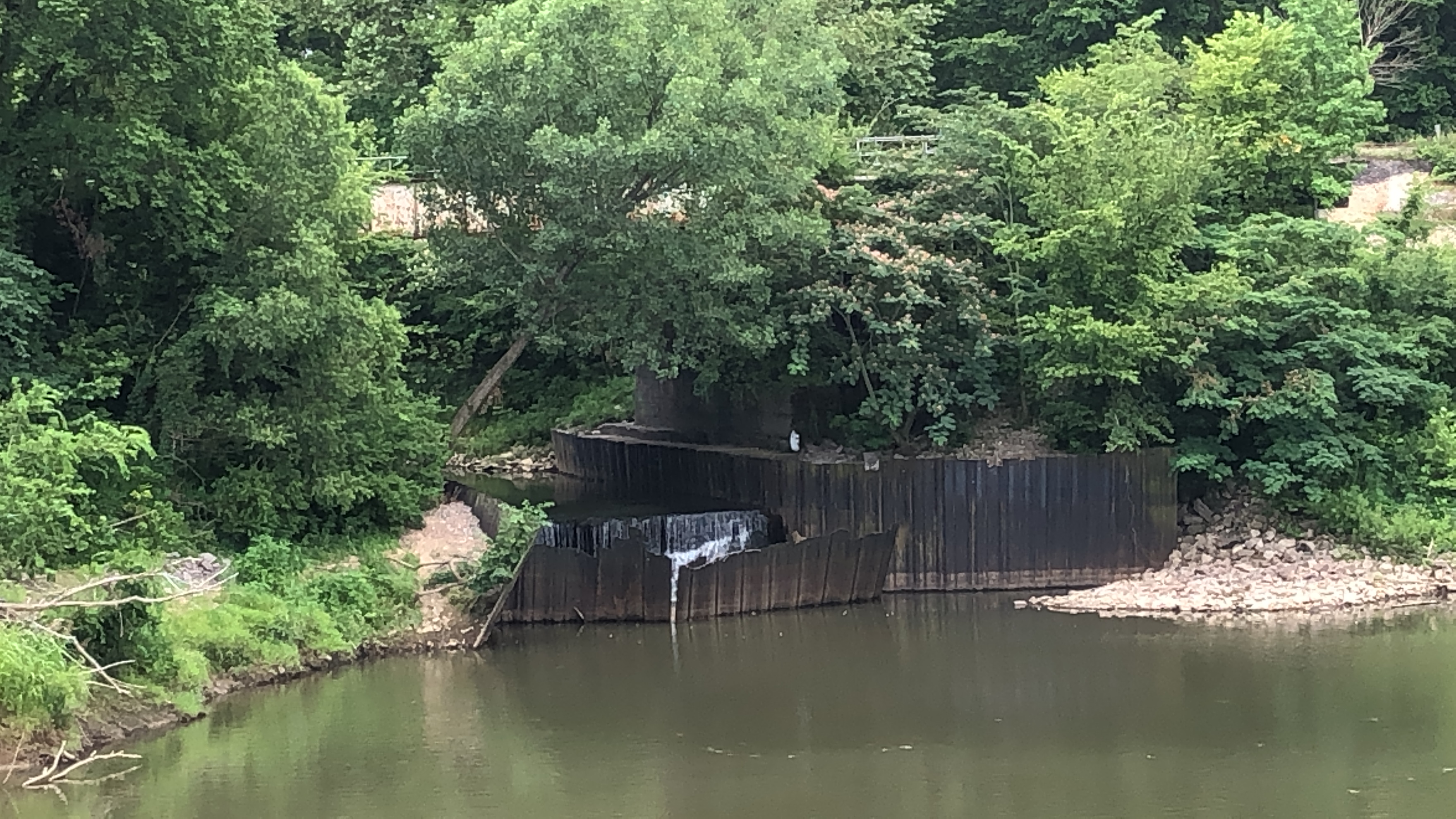
Right there at the railroad is a grade control structure that was installed under the CN Railroad. It is unraveling.  And doing so quickly.  Additional flood events will accelerate the process and increase the risk to the rail, to the residents, and to the federal investments of the levee.   


It is not clear who built the grade control structure - thankfully it is not one of ours, although if it were, we would have a mandate to address it.

Our big problem is authority here, complicated by the local sponsors and stakeholders. 

The City of Millington has the responsibility.

Shelby County has the responsibility.

The Railroad has the responsibility.

The flood protection levee is ours, and we hold some responsibility there.

Finally, there is a Highway, just upstream of the scour, where the Tennessee Department of Transportation has placed a highway and bridge, both of which are impeding the stream during high water events, as well. 

You get a call from the City, and they leave a voice mail, asking you to help address a water resource problem in your area.  Do you:

Pick up the phone and call them back?

Or, 

Go to the movies, and leave it for Monday.


CAP 206

 What?

Why in the world would you choose this authority?  It makes no sense.  You are trying to address erosion and flood risk issues, and you undertake the ecosystem part of the project?  

What kind of idiot are you?

But okay, if you say so.


But now what?  How do you turn this into an effective proposal for funding in the most competitive of our CAP authorities?  

Unless.... unless the erosion problem is the symptom and the ecosystem challenges are the root.  

The evaluation of the ecosystem benefits may work to address some of the other issues as well.  

Anyway, you have what you need.  Let's pull together some coordination funding and go out and see for ourselves.  


No Can Do Attitude

Sir, we have looked at the existing authorities, and there is just no way to make it work.

You type out the words, preparing the script to find the right words to soften the blow.  There are all of the right combinations here - there is infrastructure to protect, there are economic benefits to be gained, as evidenced by repeated flooding in the area, and  there are even possible life safety issues at stake. There are previous federal investments that can be addressed through resilient features.   There are ecosystem issues that need to be addressed.  If you were to look for the perfect project for the Corps to undertake, this would be the one.  

And you have run out of coordination funds, and the MSC lead is being a jerk and refusing to issue you more.  


This is a project that needs to be addressed systematically and with great care.  

And you have not succeeded in getting the project started. Your insomnia increases and you stare at the ceiling, wondering what you could have done to serve the people.  Maybe you would have been better as a bulldozer driver, just like your uncle said.  Or maybe a prison guard.

As a last resort, you decide to write up the results and ask a panel of participants at the annual (well, kind of annual) CAP workshop for brainstorming help.  

How do you proceed?

No, I'm really asking.  How do you proceed?